
The rupee extended its losses and slumped 60 paise to close at a record low of 77.50 (provisional) against the US dollar on Monday, pressured by the strength of the American currency overseas and unabated foreign fund outflows. Forex traders said risk appetite has weakened amid mounting concerns about inflation that may trigger more aggressive rate hikes by global central banks. At the interbank foreign exchange market, the rupee opened lower at 77.17 against the greenback, and finally settled for the day at 77.50, down 60 paise over its previous close.

Volatility in exchange rates are also expected to increase.

Vishal Sikka is equally comfortable designing cutting-edge software as he is negotiating in the boardroom.

The rupee depreciated by 9 paise and settled at its all-time low level of 83.13 against the US dollar on Wednesday, weighed down by a surge in crude oil prices and strong American currency. Forex traders said the Indian rupee depreciated as the US dollar rose to the highest levels in six months. Moreover, elevated crude oil prices also weighed on rupee.

Sensex ends 31.12 pts down at 27,319.56; Nifty falls 4.50 points to 8,219.60.
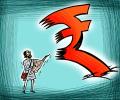
The rupee depreciated 22 paise to a record low of 78.59 against the US dollar in opening trade on Tuesday as persistent foreign funds outflows weighed on investor sentiments. At the interbank foreign exchange, the rupee opened on a weak note at 78.53 against the American dollar, then lost ground to quote at 78.59 -- its all-time low level, registering a fall of 22 paise from the last close. On Monday, the rupee declined by 4 paise to close at its life-time low of 78.37 against the US dollar.

Nearly three-fourths of the debt money, as of April 30, 2019, was invested in securities with duration of less than three years.
It's interesting how the investment scenario has radically changed over the last year or so.

SBI Life Insurance has launched SBI Life Shubh Nivesh, a traditional savings plan with an option of whole life cover.

Higher valuation creation in companies beyond the top 100 has given the domestic markets a shot at a $4 trillion market capitalisation (mcap) - a club exclusive to three countries currently. On November 23, the mcap of all BSE-listed stocks finished at a new record of Rs 328.33 trillion ($3.94 trillion), despite the benchmark indices ending with losses. The mcap was propelled by gains in the broader market, including small and midcap stocks - a trend dominant this year.

Conceding that there has been risk aversion among the lenders stemming from their rising asset quality concerns, the Governor said banks should lend to productive sectors, notwithstanding the importance of asset quality, by being discerning.

Risk aversion is currently a dominant depressant to economic recovery, points out Shankar Acharya, former chief economic advisor to the Government of India.
The private sector accounted for 30 per cent of all investment in infrastructure in the last Plan period and is supposed to mobilise 50 per cent ($500 billion) of the planned infrastructure spending for 2012-17.
State Bank of India, ICICI Bank, Bank of Baroda and Bank of India are set to book mark-to-market losses on the exposures of their foreign offices to credit derivatives, with the spreads on these widening since international lenders turned risk-averse following the crisis in the US subprime (or high-risk home loan) market. Credit derivatives are instruments for which the underlying asset is a loan or a bond.
A fixed deposit probably ranks as the most conventional investment avenue for domestic investors. More importantly, given its offering, it makes an apt choice for risk-averse investors.

The rupee depreciated 11 paise to a record low of 78.96 against the US dollar in opening trade on Wednesday, weighed down by persistent foreign capital outflows. At the interbank foreign exchange, the rupee opened on a weak note at 78.86 against the American dollar, then lost ground to quote at 78.96 -- its all-time low level, registering a fall of 11 paise from the last close. On Tuesday, the rupee plunged by 48 paise to close at record low of 78.85 against the US dollar.

Ratan TataTata Group Chairman Ratan Tata has asked all group companies to do a reality check in view of the economic slowdown, expected to continue in the New Year.

Private equity players and venture capitalists are cautiously optimistic about the prospects of their businesses, yet are hopeful of clinching more deals in the New Year, say industry experts.
A pure term life cover fulfills your needs at the lowest cost.

The rally in PSBs, analysts feel, was more a knee-jerk reaction to the development, and the actual benefits will start to accrue once the addition takes place in 2024. "The actual benefit for banks from the inclusion in JP Morgan's EM Index will accrue from June 2024 onwards. "Until then, the larger fundamentals of the market will dictate the moves. "Once the initial euphoria subsides, bond markets will look to global cues which may trigger fresh selling," said Siddharth Khemka, head of retail research, Motilal Oswal Financial Services.
The dollar also gained strength in the overseas market against the euro and other currencies.
The Indian rupee has fallen by almost 11 per cent since August 1, thanks to rising risk aversion.

Equity indices staged a pullback on Tuesday after three days of declines as investors scooped up IT, metal and consumption stocks amid a largely positive trend overseas. A recovery in the rupee added to the momentum, traders said. Overcoming a wobbly start, the 30-share BSE Sensex climbed 274.12 points or 0.45 per cent to settle at 61,418.96.
Or how you can be on top of your stock market strategy and make money.

IndusInd Bank was the top loser in the Sensex pack, tanking over 8 per cent, followed by Bajaj Finance, SBI, ONGC, Titan, M&M, Bajaj Finserv, ICICI Bank and Axis Bank. NSE Nifty plunged 524.05 points to finish at 14,310.80.

The benchmark indices are set to end their five-month gaining streak, but the market breadth continues to hold strong So far this month, stocks gaining have outnumbered those declining, a sign that the bulls still have the upper hand, even as the pullback in the S&P BSE Sensex and the National Stock Exchange Nifty indicates otherwise. On the BSE, 2,126 stocks have advanced and 1,955 have declined in August, translating into an advance/decline ratio (ADR) of 1.1.
Shares of Anil Ambani-led Reliance Communications and Reliance Infrastructure gained five per cent each on expectation that rate cuts would help lower the interest cost burden of these companies.
Nikhil and Arpita explain where they have invested their money.
Tightening financial conditions have set the stage for early Fed easing. Outside the US, there is no longer expectation of the ECB, BoJ, BoE, and BoC to hike rates this year again

It has been a choppy calendar year 2022 (CY22) for global financial markets amid the spectre of rising inflation that led most central banks, especially the US Federal Reserve (US Fed), to tighten their monetary policy. Most equity indices across the globe have seen a sharp fall from their respective peak levels in this backdrop. FTSE India, for instance, has corrected 16 per cent from its October peak.

Current account deficit occurs when a country's total imports of goods, services and transfers is greater than the country's total export of goods, services and transfers.

Market players said a big upmove by the market will depend on policy action by the government to revive economic growth and corporate earnings revival.
But cautions about some damage in short term, next three quarters may see high volatility.
Sundaram Select Small Cap Fund is one of the few NFOs that offer some unique features to the investors which will be beneficial to them in the long run.

The rupee had ended 79 paise higher to close at 55.15 against the US currency in the previous session on Friday.
The market breadth on BSE ended weak with 1,616 shares declined and 1,097 shares advanced.

According to analysts, everyone across the globe has learnt several important lessons from the financial turmoil during the past year or two, which has made them highly risk averse.
According to some foreign brokerages, reality isn't so bad. While high inflation and interest rates coupled with corporate governance issues may act as a negative overhang for the sector, valuations look attractive now.

Asian Paints was the top loser in the Sensex pack, dropping 2.16 per cent, followed by Axis Bank, Bajaj Auto, SBI, NTPC and Bajaj Finance.
The markets are surging . So what should you do?
